


“Normal” Shoes Are a Historical Mistake: Why Barefoot Shoes Make More Sense Than Ever
Shoes are such a natural part of everyday life that we rarely stop to question them. Yet few people ask whether so called “normal” shoes are actually natural for the human foot. In this article, we look at how modern footwear came to be, why it often contributes to foot pain, and how barefoot sneakers are changing the way we think about walking.
Article overview
- What do “normal” shoes really mean from a historical perspective
- How modern footwear has shaped the human foot
- Why foot pain has become so common today
- How barefoot sneakers support natural movement
- What is the real difference between conventional shoes and barefoot shoes
- Are barefoot shoes a step back or a step forward


What do “normal” shoes mean from a historical perspective?
Conventional shoes as we know them today are a relatively recent invention. For most of human history, people walked barefoot or wore simple, soft footwear designed mainly to protect the feet, not to reshape them. Shoes with narrow toe boxes, stiff heels and raised heels only became widespread in the last few centuries, largely due to industrialisation and changing fashion trends.
How has modern footwear influenced foot shape?
When the foot is confined for years in narrow, rigid shoes, it gradually adapts to that shape. Toes lose their natural space, the arch becomes less active and the muscles of the foot weaken. This process is subtle and slow, but over time it often leads to common foot issues such as bunions or hammer toes.
Why Is Foot Pain So Common Today?
Foot pain has become an almost accepted part of everyday life. Many people see it as the price of long hours standing, city walking or sport. Research suggests, however, that footwear plays a much bigger role than we tend to admit. Cushioning in conventional sneakers may reduce discomfort in the short term, but at the same time it weakens the foot’s natural ability to absorb impact and maintain stability.
How Foot Pain Most Commonly Shows Up
- Fatigue in the feet even after a short walk
- Pressure or discomfort in the heel or arch
- An unnatural or awkward feeling when stepping down
How Do Barefoot Sneakers Respect Natural Movement?
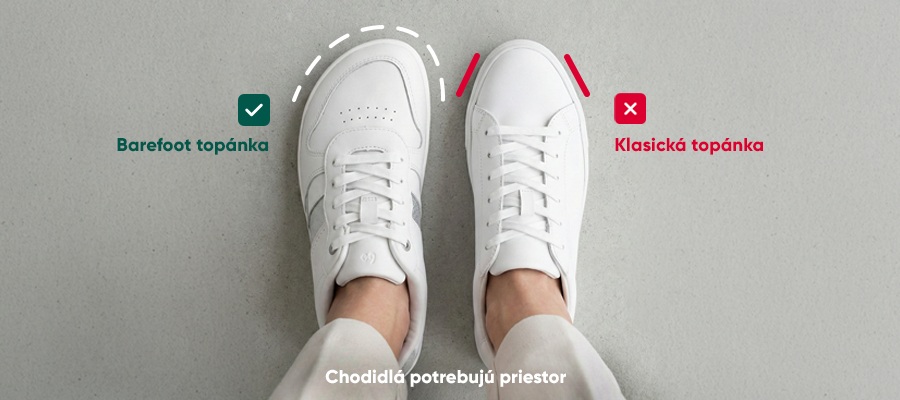
Barefoot sneakers are designed to interfere as little as possible with the foot’s natural function. They feature a wide toe box, a thin and flexible sole, and a zero drop between heel and forefoot. Thanks to this, the foot can move the way it was originally designed to move.
How Barefoot Shoes Support the Foot
- They allow the toes to spread naturally, improving overall stability
- They activate the muscles of the foot instead of replacing their function
- They enhance sensory feedback from the ground, which can have a calming effect on the brain
What Is the Difference Between Conventional Shoes and Barefoot Shoes?
| Feature | Conventional shoes | Barefoot shoes |
| Toe shape | Narrow | Wide |
| Sole | Thick and cushioned | Thin and flexible |
| Heel | Raised | Zero |
| Toe movement | Restricted | Natural |
Are Barefoot Shoes a Step Back or a Step Forward?
Barefoot shoes are not a rejection of modern life, nor a nostalgic return to the past. They are a return to principles that respect human anatomy and natural movement. Combined with urban friendly design and high quality materials, barefoot shoes represent a modern, forward thinking approach to everyday movement.
So What Does This All Mean?
So called “normal” shoes were shaped more by fashion and industrial efficiency than by the actual needs of the human foot. Barefoot sneakers offer an alternative that respects natural movement, reduces the risk of foot deformation, and may help prevent foot pain over time. This is not just another trend. It is a return to function and to walking the way the body was meant to move.
Find your size with our size guide.
Explore the current barefoot sneakers collection.
Contact us if you need advice.
Are barefoot sneakers suitable for everyday wear?
+ -Yes. With a gradual transition, barefoot sneakers are suitable for everyday city wear as well as longer walks.
Can barefoot shoes help with foot pain?
+ -Many people experience improvement because the foot begins to function in a more natural way.
Do barefoot shoes cause flat feet?
+ -No. On the contrary, they support active use of the arch muscles.